Road field notes
Roads Along the Water
Plan a drive around the stops and connections that make it worthwhile. A fjord road is not simply the scenic alternative to a faster road; sometimes it is a different journey altogether.
Read the route beyond the distance
Western Norway’s geography makes distance an unreliable measure of effort. A short road can include hairpins, single-width sections and repeated stops for oncoming traffic. A longer tunnel route may be the more predictable choice when you need to reach a booked crossing or accommodation.
Begin by marking the overnight destination and any fixed departure. Then add one scenic section. Treat additional viewpoints as optional rather than building a day that works only if every road is clear and every ferry arrives just as you do. Navigation estimates are useful starting points, but they do not include the time spent finding parking, walking to a lookout or waiting in a queue.
Download the relevant map before leaving reliable reception. Carry enough fuel or battery range to bypass a closed section without relying on a single rural stop. If using an electric vehicle, check charger availability and payment arrangements independently of your navigation app.
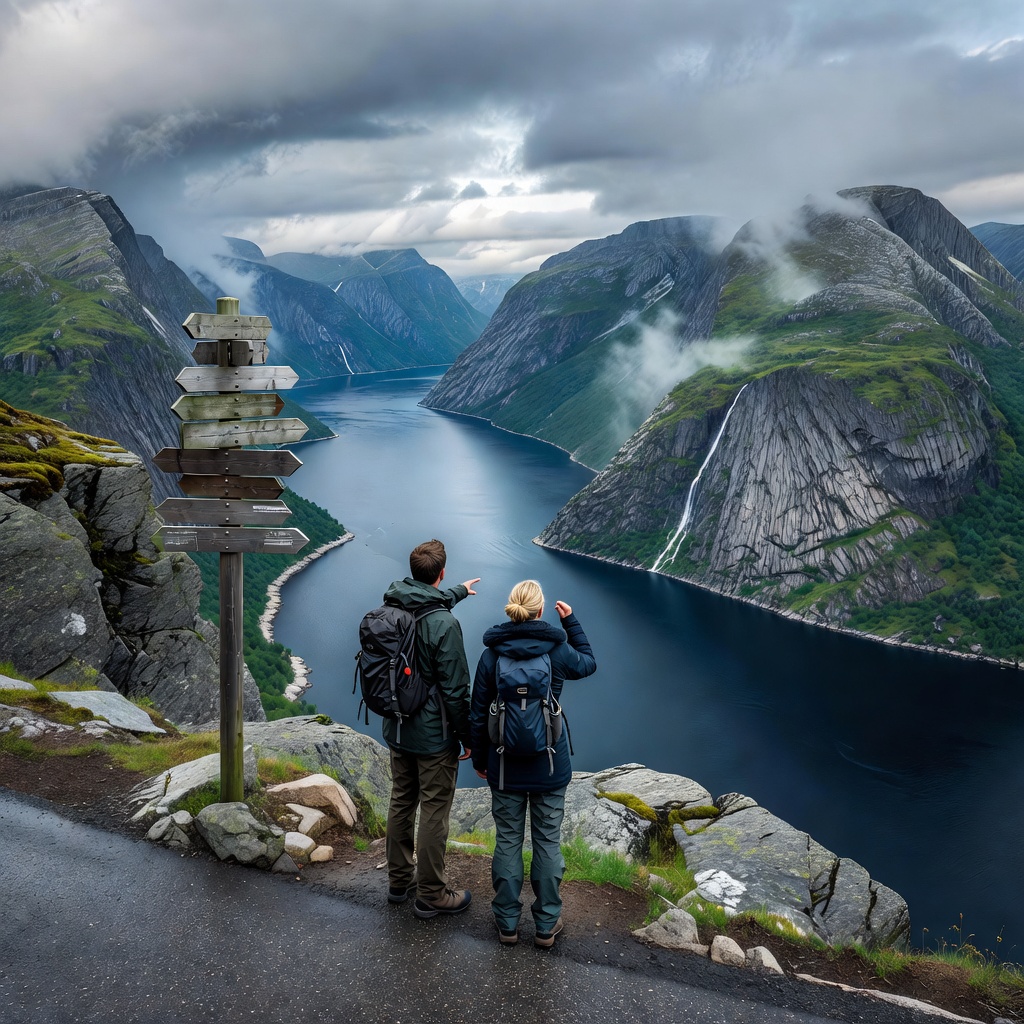
Aurlandsfjellet: distinguish the viewpoint from the crossing
Aurland is a useful place to understand how different roads serve different purposes. The Stegastein viewpoint sits above Aurlandsfjord on the approach to Aurlandsfjellet. The higher mountain crossing is seasonal, while the lower approach has a different access pattern. Do not interpret an accessible viewpoint as proof that the entire mountain road is open.
The Lærdal Tunnel offers an alternative connection between Aurland and Lærdal, but a tunnel journey and a mountain excursion are not interchangeable experiences. If your priority is the high landscape, check the Norwegian Scenic Routes information and current road status before setting out. If your priority is reaching the next base, decide early when to abandon the scenic option.
At Stegastein, parking space and pedestrian activity can make a brief stop take longer than expected. Park only where permitted, keep the road clear and do not stop in a bend to take the photograph you missed.
Hardanger: give the shoreline its own day
Hardangerfjord rewards a slower approach through settlements such as Norheimsund, Øystese, Kinsarvik and Eidfjord. They are not all quick additions to the same day. Choose a manageable shore section and connect it to your overnight stop, rather than trying to trace every inlet on the map.
Waterfalls, orchard landscapes and short waterfront walks can fill the gaps between larger attractions. These stops still require legitimate parking and, sometimes, a walk along a local road. Do not enter orchards or farmyards without permission. A tempting track may be someone’s working access rather than a public viewpoint.
Keep a wet-weather version of the day: fewer exposed stops, a village walk when conditions allow and a shorter driving objective. Low cloud can hide the mountains without making the shoreline uninteresting.
Geiranger: check every approach separately
Geiranger’s road network includes steep approaches and seasonal high ground. Conditions on one approach do not tell you whether another is usable. Check the exact road numbers and junctions on your intended route, particularly if arriving from or continuing toward a mountain crossing.
Allow for coaches, slower vehicles and busy lookout parking. An early start may help with pacing, but it does not guarantee an empty road. Never use a passing place as a long-stay photo location. If the signed parking is full, continue to a safe alternative instead of creating a second row on the carriageway.
Consider staying nearby rather than treating the fjord as a distant turnaround point. That gives you a chance to walk through the village and see the shore outside a compressed midday visit, without promising solitude.
A simple road-day method
- Check current traffic notices and the weather before departure.
- Choose one principal scenic stretch and a practical fallback.
- Identify legal parking for the stops you most want.
- Work backward from the last essential ferry or check-in.
- Drop an optional stop if the day starts slipping.
Local signs and closures take priority over any saved itinerary. This guide is a planning framework, not live road information.